
Weathering This Week's Storm
Sustaining Professional Learning in Turbulent Times

The budget went down in several of the school systems I serve in a sustained way last night.
I woke up early to this news, listening through my earbuds as I cleared the remnants of a massive tree branch from our front lawn. A storm took it down just before dawn. Most of it fell into the bed of a neighbor’s truck. The rest showered down over the hood of our car. No damage, really. Just a scratch.
We’ll clean up and adjust to the landscape in front of us that is changing all over again.
And as I was listening and sweeping, I thought to myself: It will always be this way now.
That reality has driven many of my friends in learning facilitation work out of the field entirely—especially those who chose to consult independently. Only a few in my original circle remain. And I’m still here, but I want to be honest: I’m here because I’ve continued to iterate on what I offer and how I offer it.
My days look entirely different than they did in 2008. 2010. 2015. 2021.
2025
Yeah, they look much different now than they did at this time just last year.
And that hasn’t been a bad thing for me, personally or professionally. But the fact is that this consultancy is one I continue to build and rebuild with careful intention. And here’s something few who do what I do for a living are talking about openly right now: Just because we’re sustaining our businesses well doesn’t mean that any of the professional learning we’re responsible for in the systems we care about will be satisfying or sustainable unless we design it in ways that are better able to withstand neverending storms.
Tools like Care-Capacity Framework help me partner with people more honestly, inside of this reality. And stacking PD isn’t just a nice bonus feature of working with me, either. It’s necessary. You can read more here if you’re unaware of what I mean.
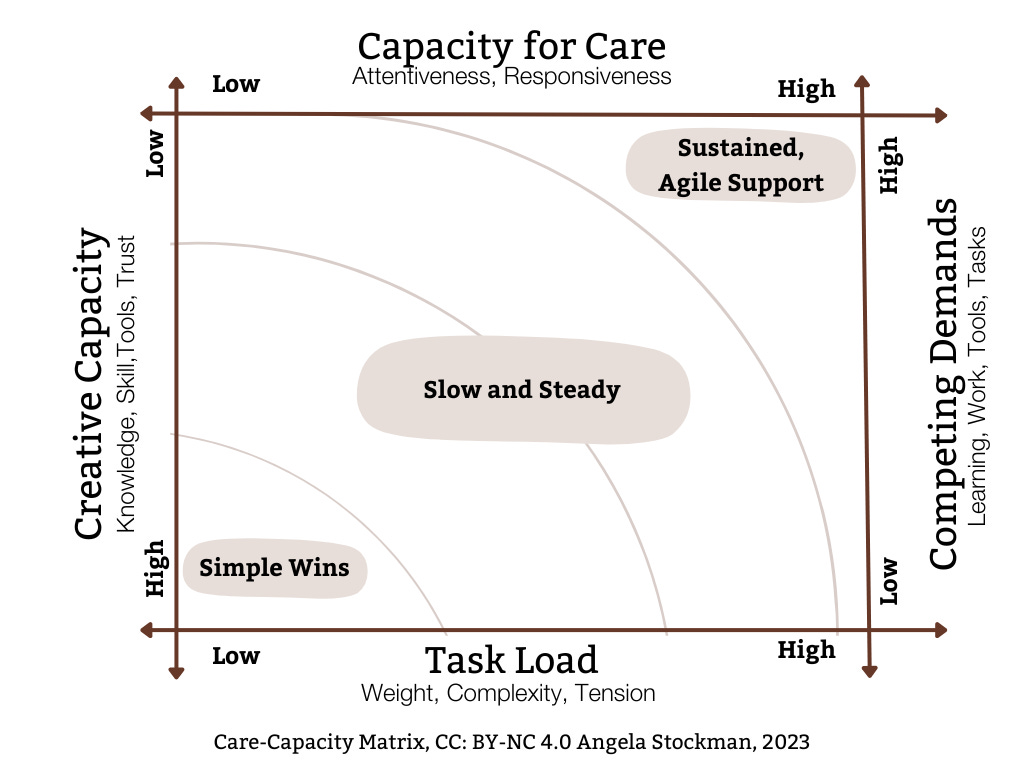
This is how I sustained professional learning experiences during COVID. It’s how we kept making strides together in the systems that I serve long term. The return on that investment has been satisfying. It’s given me hope.
Learning continues, come what may.
How?
As I explained on Sunday, stacking multimodal micro-learning experiences around an anchor offer makes for agile and deeply responsive PD. Here are four tight steps you can take to begin moving in this way—today.
Four Steps to Stacking PD
First, anchor your design to what matters most. It’s important to define what people will learn, but consider how you would like their thinking, learning, or work to change as well. Define the WHAT but also get clear about the HOW and WHY. Design strategic plans, sure. Do better here, though. Situate those plans inside of real theories of change.
Second, inventory what is inside of that richer experience. Put a close eye on your content for a minute. List the frameworks, exercises, readings, protocols, conversations, and multimedia content that fuel the learning. Be granular. A six-month cohort can easily contain dozens of distinct content components if you look closely. Determine which offerings build knowledge, which invite participants to connect concepts, ideas, learning moments, and work together, and which invite transfer to their actual classrooms? Categorize these opportunities in this way.
Third, ask what each component could become. A framework can become a downloadable one-pager that teachers can take for a test drive before meeting with you to share their learning stories. That one-pager can also live inside of a protocol. That protocol might fuel a peer review process between local colleagues or perhaps, in virtual community with others beyond the system. Asynchronous course modules might replace physical visits to schools, where teachers are pulled from classrooms and the need for subs is higher. Adult learners might apply a step-by-step process to their own designs by listening to you coach them through it one podcast episode at a time. They might sign up for 1:1 office hours with you as well or bring a department or grade level team to a fireside chat online. Brainstorm a ton of possibilities. Exhaust your ideas here. Ask colleagues and friends to contribute more. Expand the offerings inside of each category that emerged in step two.
Fourth, look at the people you are designing for and where they live on the Care-Capacity Matrix. Then consider: Which offers meet them where they are right now? And then, how might you move forward from this place, when they’re ready and able? This challenges you to consider how offers connect inside of a true learning progression. It challenges you to keep the constraints of our current reality front and center as you do so, too.
Wanna Play With This?
The Intentional Facilitator is one anchor that I’m tinkering with right now. On Sunday, I’ll begin cutting tiny offers from that larger one and sharing them here, across a true learning progression.
If you would like to watch me “stack” a professional learning experience from inside of my own work and experience that PD yourself, drop by on Sunday. Let’s play.
It is interesting to read your materials for professional learning facilitators, even though I exist as a classroom teacher in my realm. The thought processes are all the same ones that I can adapt for classroom use--shift and change with my own population. Though they are required to be there, the need varies, and I, too, need to shift and change. Grateful you are still here...